HELENE BAILLY MARCILHAC
Kees van Dongen , Netherlands
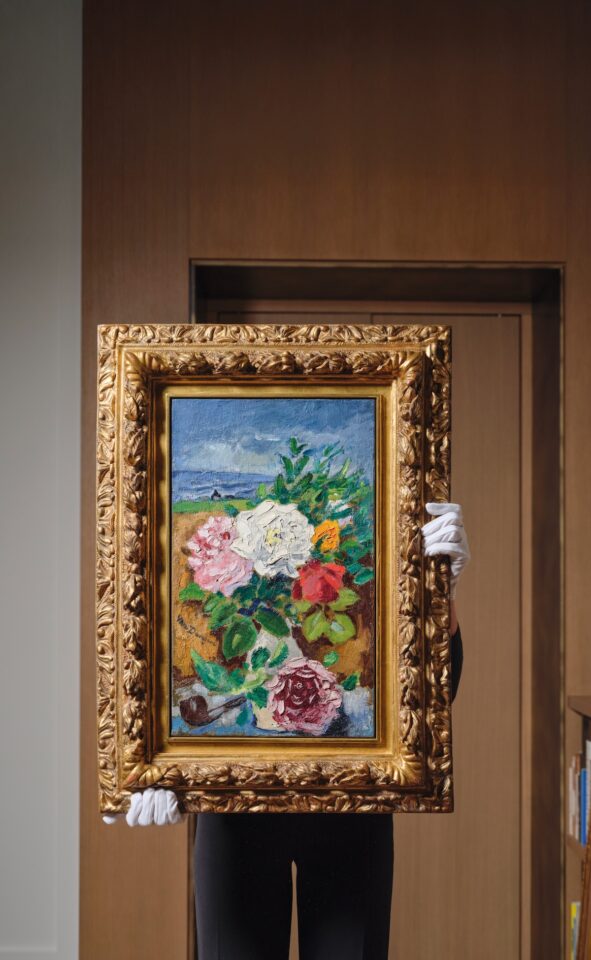
Kees van Dongen, Composition Florale, Avec Une Pipe, circa 1945-1950 © HELENE BAILLY MARCILHAC
The HELENE BAILLY MARCILHAC Gallery is honored to present a monographic exhibition dedicated to Kees van Dongen (1877–1968), a major and singular figure of twentieth-century modern art. Born in Delfshaven near Rotterdam and permanently settled in Paris by the end of the nineteenth century, van Dongen quickly established himself as an independent artistic personality, developing a distinctive vision of portraiture and color that consistently fueled debates on pictorial modernity.
Associated from 1905 onward with the Fauvist avant-garde, Kees van Dongen took part in the vibrant atmosphere of the Salon d’Automne, whose chromatic intensity earned the movement the name Fauves, coined by the critic Louis Vauxcelles. Although he was not exhibited that year in Room VII, later famously known as the Fauves’ Room, alongside Matisse, Derain, and Vlaminck, his pictorial research nonetheless fully aligned with this new dynamic.
By the end of that year, his participation in the exhibition at the Prath & Maynier bookshop firmly linked him to the group and strengthened his ties with the principal figures of Fauvism. A few years later, Vauxcelles would describe him as one of the most terrifying of the Fauves (Gil Blas, March 4, 1908), underscoring the expressive force and radical nature of his pictorial language.
Unlike many of his contemporaries, van Dongen preserved this expressive freedom of color throughout his life, refusing any form of academic orthodoxy. His painting remained a constant exploration of pictorial emotion and human presence, driven by an immediately recognizable chromatic intensity.
Van Dongen was not merely Fauvist in technique. He was also a painter of modern life, of the city and the world of society. His work reflects the effervescence of Parisian life between Montmartre and Montparnasse, capturing its cosmopolitan impulses, festivities, literary cafés, and soirées where writers, artists, and social figures converged. His art offers a vivid portrait of Paris from the 1900s to the 1930s, marked by sensuality, chromatic audacity, and an acute sense of portraiture, which earned him particular recognition among both high society and a broad public.
Art historians have often emphasized that van Dongen elevates color to an expressive power that surpasses mere representation, making his work an essential reference for understanding the evolution of modern portraiture. His female figures, associated with elegance, emancipation, and psychological complexity, capture both the spirit of an era and a more intimate dimension of the artist’s gaze.
At the HELENE BAILLY MARCILHAC Gallery, we are especially proud to present several key works from this singular trajectory, allowing visitors to grasp the many facets of van Dongen’s approach, from his early Fauvist explorations to his society portraits. This monographic exhibition thus offers a rich and nuanced reading of an artist who remained profoundly Fauve in spirit as well as in his use of color throughout his career.Solo show of Moïse Kisling
Solo show by Kees van Dongen
From March 24 to June 31, 2026
The gallery
Founded in 2007 by Hélène Bailly Marcilhac, the eponymous gallery has established itself as a reference in the field of Impressionist, Modern, and Post-War art. Recognized for its scholarly approach and museum-level standards, the gallery develops a program that brings artistic movements and periods into dialogue, offering new confrontations and a carefully curated selection of works.
The gallery places particular emphasis on major artists such as Edgar Degas, Albert Marquet, Kees van Dongen, Pablo Picasso, Francis Picabia, Joan Miró, Alexander Calder, Victor Brauner, Alberto and Diego Giacometti, and Claude and François-Xavier Lalanne, among many others. Each exhibition is accompanied by authoritative catalogues produced in collaboration with leading art historians, reflecting the gallery’s commitment to rigor and the sharing of knowledge.
Located at 71, rue du Faubourg Saint-Honoré in Paris, the gallery upholds a tradition of expertise and excellence. It plays an active role in the research and documentation of major artists, notably through its involvement in the preparation of catalogues raisonnés, including those of Léon Pourtau and Henri Delavallée, as well as its contribution to Volume IV of the Francis Picabia Catalogue Raisonné.
Deeply anchored in the institutional and academic art world, the gallery works closely with leading French and international institutions such as the Musée d’Orsay, the Musée du Quai Branly, and the Musée de Montmartre in Paris; the Fondation de l’Hermitage in Lausanne; the Museum of Modern Art in New York; the National Gallery of Victoria in Melbourne; and the Singer Laren Museum in the Netherlands. These partnerships reflect its commitment to facilitating the circulation of artworks, encouraging exhibition loans, and supporting ambitious research initiatives.
Gallery artists
Cuno Amiet, Bathus, Pierre Bonnard, Eugène Boudin,Victor Brauner, Bernard Buffet, Rembrandt Bugatti, Alexander Calder, Charles Camoin, Manuel Cargaleiro, Mary Cassatt, Auguste Chabaud, Marc Chagall, Giogio De Chriciro, Henri-Edmond Cross, Edward Cucuel, Salvador Dali, Nicolas de Staël, Edgar Degas, Robert Delaunay, Sonia Delaunay, Maurice Denis, Óscar Dominguez, Hisao Domoto, Albert Dubois-Pillet, Jean Dubuffet, Marcel Duchamp, Raoul Dufy, Max Ernst, Maurice Estève, Léonard-Tsuguharu Foujita, Sam Francis, Paul Gauguin, Alberto Giacometti, Diego Giacometti, Françoise Gilot, Jean Hélion, Hans Hartung, Jean Hélion, Auguste Herbin, Blanche Hoschedé-Monet, Ernst Ludwig Kirchner, Moïse Kisling, Frantisek Kupka, Yayoi Kusawa, Claude Lalane, François-Xavier Lalane,Achille Laugé, Marie Laurencin, Henri Laurens, Le Corbusier, Henri Le Sidanier, Fernand Léger, Gustave Loiseau, Maximilien Luce, Charles Macaire, Aristide Maillol, Henri Manguin, Louis Marcousis, Albert Marquet, Henri Martin, Georges Mathieu, Henri Matisse, Jean Metzinger,Joan Miró, Claude Monet, Henry Moore, Emile Othon-Friesz, Jean Peské, Hippolythe Petitjean, Francis Picabia, Pablo Picasso, Camille Pissarro, Serge Poliakoff, Odilon Redon, Pierre-Auguste Renoir, Jean-Paul Riopelle, Auguste Rodin, Alberto Savino, Arthur Segal, Paul Sérusier, Georges Seurat, Paul Signac, Alfred Sisley, Pierre Soulages, Chaïm Soutine, Sam Szafran, Chu Teh-Chun, Henri Toulouse-Lautrec, Marie Cerminova dite Toyen, Félix Vallotton, Louis Valtat, Kees Van Dongen, Maria Elena Vieira Da Silva, Maurice de Vlaminck, Alexej von Jawlensky, Edouard Vuillard, Zao Wou-Ki, Ossip Zadkine